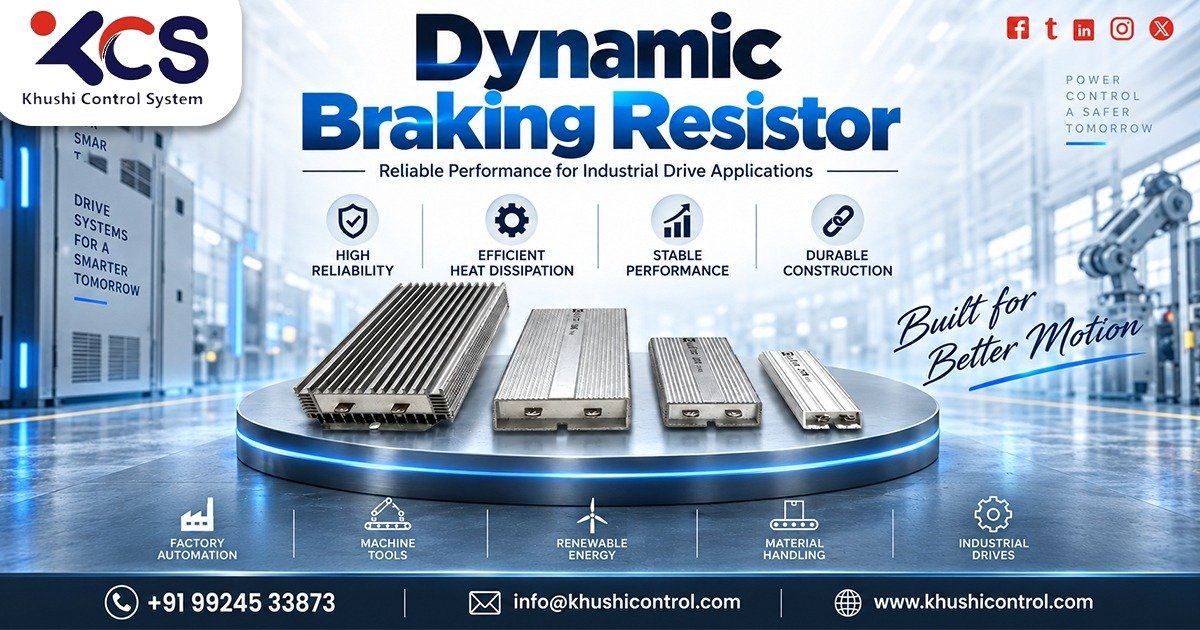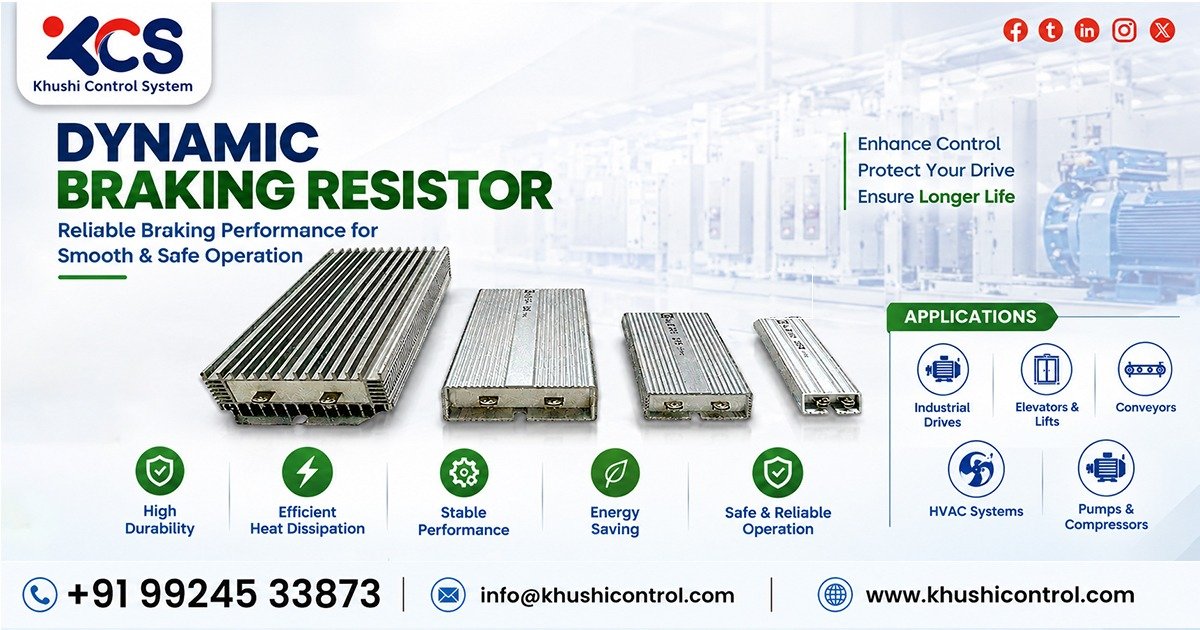
A dynamic braking resistor (DBR) is a power resistor that absorbs and dissipates the excess regenerative energy produced when an electric motor slows down.
It converts that energy into heat, which protects the VFD or drive from overvoltage faults and brings the motor to a faster, controlled stop.
We are based in Ahmedabad, Gujarat, India.
What Is a Dynamic Braking Resistor?
- A dynamic braking resistor is an energy-dissipating device connected to a Variable Frequency Drive (VFD), servo drive, or DC bus.
- It works as a controlled “energy sink” during motor deceleration or overhauling loads.
- It is built from heavy-duty resistive elements such as wire-wound, aluminum-housed, or stainless-steel grid resistors.
- It is also called a brake resistor, braking resistor, or regenerative load resistor.
Why Is Dynamic Braking Needed?
- Motors become generators: When a motor decelerates faster than its load, it feeds energy back into the drive.
- DC bus voltage rises: This surplus energy pushes the DC bus voltage beyond safe limits.
- Drives trip: Without a way to dispose of it, the drive shows overvoltage (OV) faults and stops unexpectedly.
- Hardware is at risk: Repeated voltage spikes damage capacitors, IGBTs, and other drive parts.
Components of a Dynamic Braking System
- VFD or servo drive: Controls motor speed and torque.
- Braking chopper: The switching unit, built into the drive or installed externally.
- Braking resistor: Absorbs and dissipates the excess energy.
- Thermal protection: A thermostat or thermal relay that guards against overheating.
Benefits of Using a Braking Resistor
- Faster, controlled stops: Shortens stopping time for high-inertia loads.
- Fewer drive trips: Prevents nuisance overvoltage faults.
- Longer equipment life: Protects drive electronics and motors.
- Better safety: Gives predictable stopping behavior in critical operations.
- Higher productivity: Reduces downtime and speeds up cycle times.
FAQs
Q1: What does a dynamic braking resistor do?
A1: It absorbs the regenerative energy a motor sends back to the drive during deceleration and converts it into heat, preventing overvoltage trips.
Q2: Do all VFDs need a braking resistor?
A2: No. It is needed mainly for high-inertia loads, rapid stops, frequent braking, or overhauling loads such as hoists and cranes.
Q3: How do I calculate the braking resistor value?
A3: Use the formula R = V²DC / P(brake), where VDC is the braking voltage threshold. The value must stay at or above the drive’s minimum resistance.
Q4: Why does a braking resistor get hot?
A4: It converts electrical energy into heat by design. Proper ventilation, correct power rating, and thermal protection keep that heat safe.
Q5: What happens if the braking resistor is undersized?
A5: It can overheat, fail early, cause overvoltage faults, or become a fire hazard. Always size it for the duty cycle and peak energy.
Q6: What is the difference between a braking resistor and a braking chopper?
A6: The chopper is the switch that senses DC bus voltage and connects the circuit. The resistor is the load that dissipates the energy.
We Supply Dynamic Braking Resistor in India including locations Andhra Pradesh, Arunachal Pradesh, Assam, Bihar, Chandigarh, Chhattisgarh, Dadra and Nagar Haveli and Daman and Diu, Delhi, Goa, Gujarat, Haryana, Himachal Pradesh, Jammu and Kashmir, Jharkhand, Karnataka, Kerala, Ladakh, Madhya Pradesh, Maharashtra, Manipur, Meghalaya, Nagaland, Odisha, Puducherry, Punjab, Rajasthan, Sikkim, Tamil Nadu, Telangana, Tripura, Uttar Pradesh, Uttarakhand, West Bengal.
Stop drive trips and stop faster: get your custom braking resistor from Khusi Control System today!
Website: www.khushicontrol.com
Email Id: info@khushicontrol.com
Phone No: +91 99245 33873
View Product: Click here